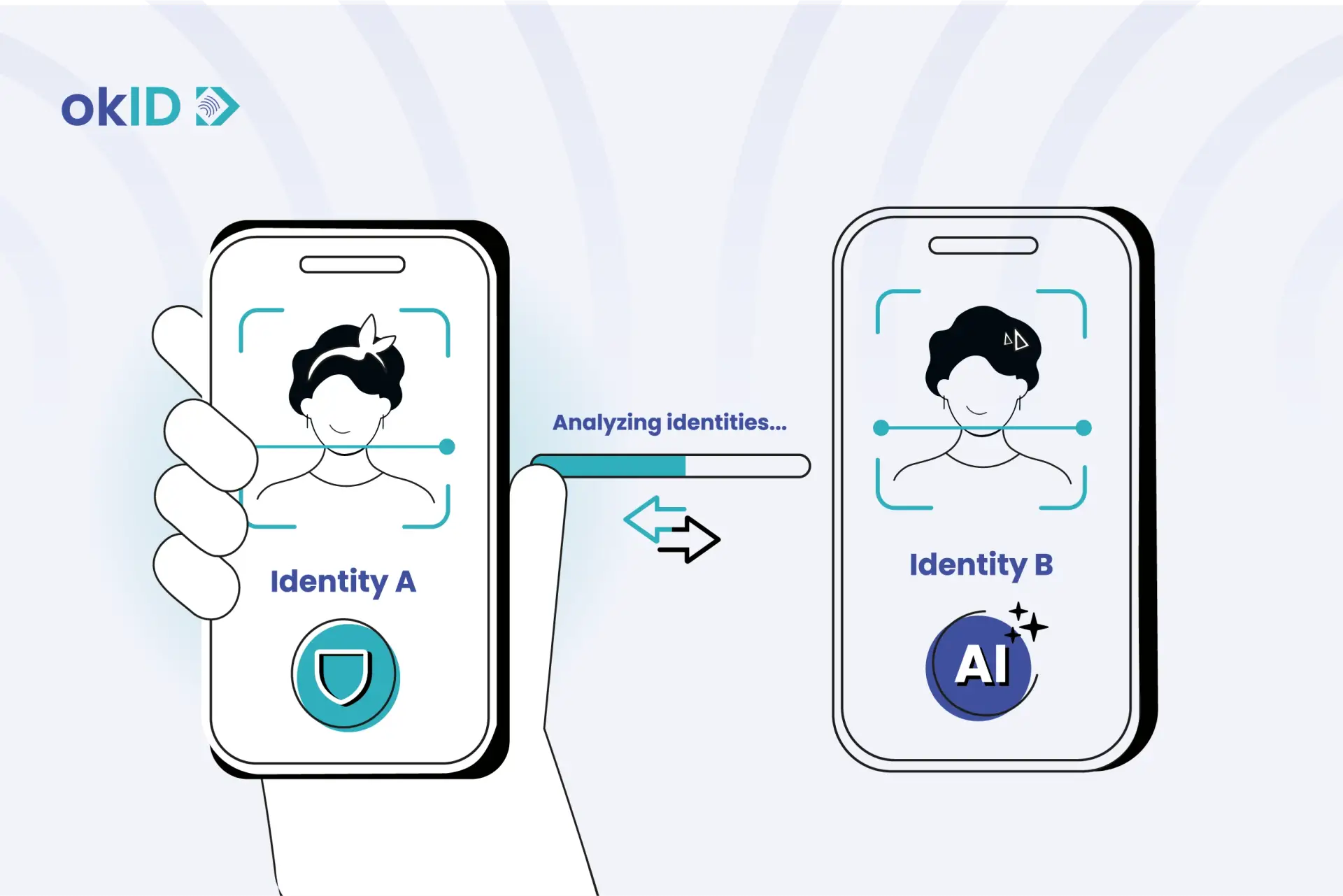
Biometric spoofing is becoming harder for businesses to ignore. According to the UK government, an estimated 8 million deepfakes were shared in 2025, up from 500,000 in 2023. That is a 16x increase in only twoHow Businesses Can Prevent Biometric Spoofing years. In identity verification, the risk is now showing up directly: deepfakes account for one in five biometric fraud attempts, while deepfake selfie attempts increased by 58% in 2025.
That shift changes the threat model for any business that relies on remote onboarding, KYC, account access, age checks, or digital identity verification. Fraudsters are no longer limited to stolen passwords or fake documents. They can use AI-generated faces, replayed videos, virtual cameras, and manipulated verification sessions to bypass biometric security.
The business question is whether your verification process can detect it before a fake user becomes an approved customer.
Key Takeaways
- Biometric spoofing uses fake or manipulated biometric traits to impersonate real users.
- Fraudsters use photos, videos, masks, deepfakes, and injection attacks to bypass biometric checks.
- AI has made spoofing attacks cheaper, more realistic, and easier to scale.
- Liveness checks help, but they cannot protect the entire verification journey on their own.
- The strongest defense combines biometrics, document verification, NFC checks, fraud detection, and risk analysis.
What Is Biometric Spoofing?
Biometric spoofing means using a fake, stolen, synthetic, or manipulated biometric signal, such as a face, fingerprint, voice, photo, video, mask, or deepfake, to trick a verification system into accepting an attacker as a legitimate user.
In a basic attack, a fraudster may hold a printed photo in front of a camera. In a more advanced attack, they may use a deepfake video, a virtual camera feed, or synthetic biometric data to make the system accept a fake identity.
The risk is high because biometric checks are often trusted more than passwords, PINs, or uploaded documents. If a system accepts a spoofed face or fingerprint, the attacker may be able to open an account, pass onboarding, reset credentials, access a protected service, or take over an existing profile.
Biometric spoofing is different from general identity theft. Identity theft may involve stolen names, addresses, credentials, or documents. Biometric spoofing specifically targets the biometric layer businesses use to confirm presence, identity, or account ownership.
How Criminals Perform Biometric Spoofing Attacks
Criminals perform biometric spoofing by either presenting fake biometric traits to a capture device or manipulating the data flow behind the verification process.

Photo Attacks
A photo attack uses a printed or digital image of a real person. This is one of the simplest forms of biometric spoofing, but it can still work against weak selfie checks that only confirm a face is visible.
Fraudsters may collect images from social media, leaked profiles, stolen IDs, or compromised accounts. Stronger systems look for depth, texture, lighting behavior, and other signs that the subject is a real person rather than a flat image.
Video Replay Attacks
A video replay attack uses pre-recorded footage of a person. The attacker may play the video on another phone, tablet, or laptop during verification.
This can be more convincing than a static image because it includes blinking, movement, and facial changes. If the system asks for predictable actions, such as smiling or turning the head, prepared footage may still bypass weak controls.
Deepfake Attacks
Deepfake attacks use AI-generated or AI-manipulated media to imitate a real person. Unlike a simple replay attack, a deepfake can generate realistic facial movement, expressions, and sometimes speech.
This is especially risky for remote onboarding and account recovery. Attackers can create convincing identity signals without the real person being present. As deepfake tools become easier to access, these attacks become faster and more scalable.
3D Mask Attacks
A 3D mask attack uses a physical mask or facial model to imitate another person. These attacks are less common than digital attacks, but they matter for high-risk use cases.
A high-quality mask can imitate facial structure and depth better than a printed image. Businesses that rely only on surface-level facial recognition may struggle to detect this type of attack without stronger anti-spoofing and risk checks.
Injection Attacks
Unlike photo, replay, or mask attacks, injection attacks do not rely on presenting something to a camera. Instead, the attacker attempts to bypass the capture process and inject manipulated biometric data directly into the verification workflow.
Examples include virtual camera software, synthetic video feeds, manipulated API requests, or malware that replaces legitimate biometric input with fraudulent data.
Because the camera itself may never see the fake content, injection attacks are often harder to detect than traditional presentation attacks. Businesses that rely only on front-end liveness checks may miss these attacks entirely if they do not validate the integrity of the device, session, and verification pipeline.
Why Biometric Spoofing Is Becoming a Business Risk
Biometric spoofing is growing because fraud has become easier to industrialize. Attackers can combine stolen personal data, fake documents, synthetic media, device manipulation, and automated tools into repeatable workflows.
For businesses, the impact can appear across the customer journey:
- Fake account creation during onboarding
- Account takeover through weak recovery flows
- Fraud losses after approved verifications
- More manual reviews for operations teams
- Compliance exposure when KYC checks fail
- Lower trust in remote onboarding
- Higher abandonment if fraud controls become too strict
A typical biometric spoofing attack rarely relies on one technique. A fraudster may use a stolen identity, generate a deepfake selfie, submit a manipulated ID document, connect through a device that hides its real characteristics, and repeat the process across dozens of accounts.
Each signal may look harmless on its own. Together, they create a coordinated fraud workflow designed to bypass systems that only check one layer of risk.
That is why businesses need to verify four layers: the person, the document, the device, and the session.
okID supports this layered approach by checking whether the face is live and matches the document, whether the ID data can be extracted and validated through OCR, MRZ/barcode reading and NFC, and whether device or session signals suggest automation, location risk, or suspicious behavior.
This helps businesses look beyond a single selfie or document check. A deepfake may look convincing, but the wider verification context can reveal whether the person, document, device, and session belong together.
Presentation Attacks vs. Injection Attacks
Biometric spoofing falls into two major categories: presentation attacks and injection attacks.
A presentation attack happens when the attacker presents a fake biometric trait to the sensor. Examples include a printed photo, a replayed video, a mask, or a fake fingerprint.
An injection attack is different. Instead of tricking the camera, the attacker manipulates the verification pipeline and feeds fake data into the system. The World Economic Forum has described deepfake-based KYC attacks as multi-stage workflows that may include stolen or AI-generated documents, face-swapping, camera-injection tools, and device obfuscation.
| Factor | Presentation Attack | Injection Attack |
| Attack method | Fake trait shown to the sensor | Fake data was inserted into the system |
| Examples | Photo, video, mask, fake fingerprint | Virtual camera, manipulated API input, synthetic media feed |
| Main target | Capture device | Verification workflow or data pipeline |
| Detection challenge | Is the subject live? | Is the data source trusted? |
| Business risk | Weak front-end verification | Deeper process compromise |
Businesses cannot protect only what happens on camera. A reliable verification flow should also be able to detect deepfake selfies, replay attacks, virtual camera injection, stolen-document scenarios, NFC validation failures, and suspicious session behavior.
Signs Your Business May Be Vulnerable to Biometric Spoofing

Many businesses do not realize they have a spoofing problem until fraud appears after onboarding. The warning signs often appear in operational data before they manifest as obvious attacks.
Your verification process may be vulnerable if you notice:
- High onboarding approval rates followed by fraud losses
- Repeated selfie or document resubmissions from similar devices
- Multiple accounts linked to the same IP range, device, or behavior pattern
- Unusual verification success rates from high-risk channels
- Manual reviewers are seeing more “almost real” selfies or documents
- Account takeovers shortly after successful biometric checks
- Higher abandonment after adding stricter fraud controls
These signals do not always prove biometric spoofing. But they suggest that the business needs a stronger identity risk analysis. The goal is to more accurately separate genuine customers from suspicious attempts.
How Businesses Can Prevent Biometric Spoofing
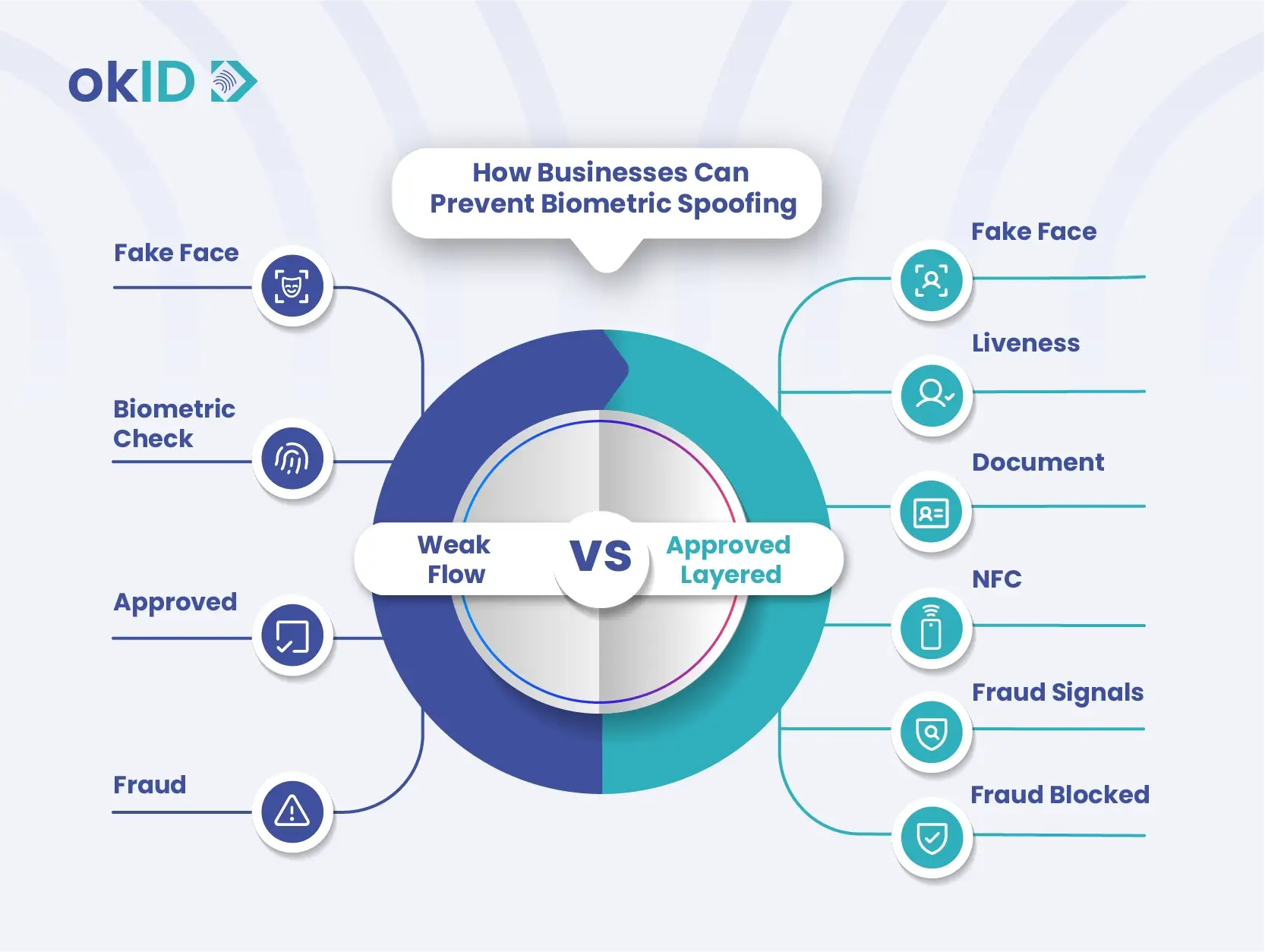
Businesses can reduce biometric spoofing by combining face liveness detection, document verification, biometric matching, NFC validation, device intelligence, fraud detection, and risk-based verification into one layered identity workflow.
Use Liveness Detection
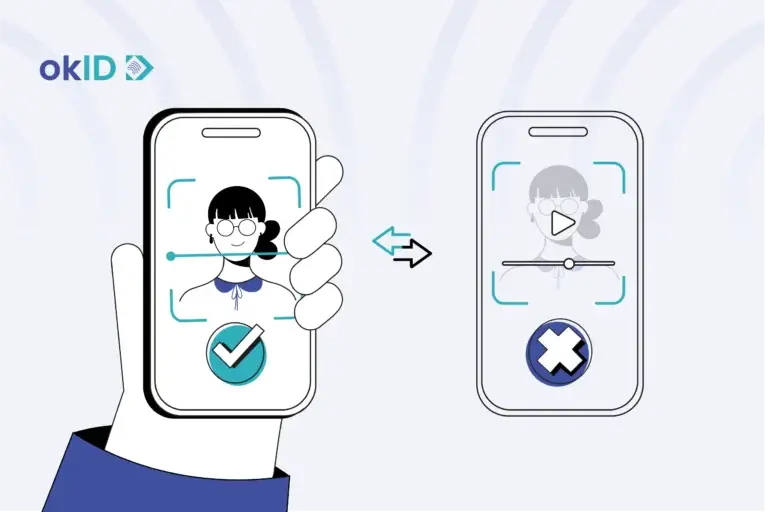
Liveness Detection helps determine whether the biometric sample comes from a live person rather than a photo, video, mask, or synthetic source.
It can be passive, active, or hybrid. In this context, the important point is simple: liveness is a valuable control, but it should not carry the entire fraud strategy. It helps with presentation attacks, but businesses also need protection against injection attacks, document fraud, risky devices, and suspicious session behavior.
Combine Biometrics With Document Verification
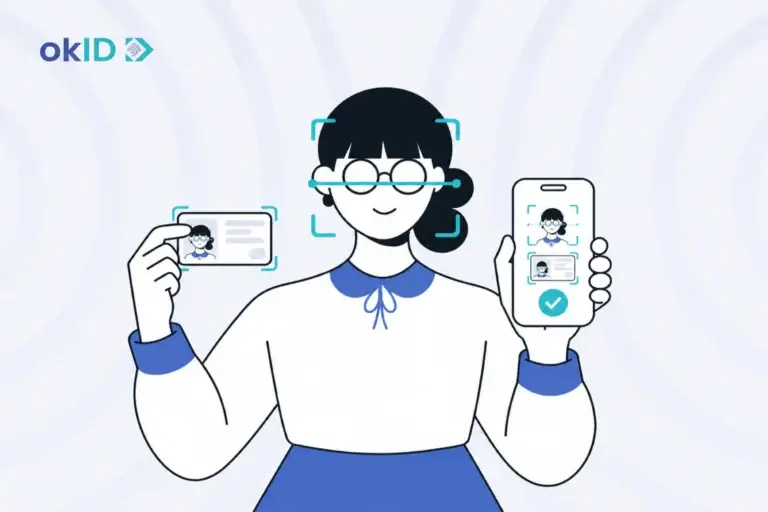
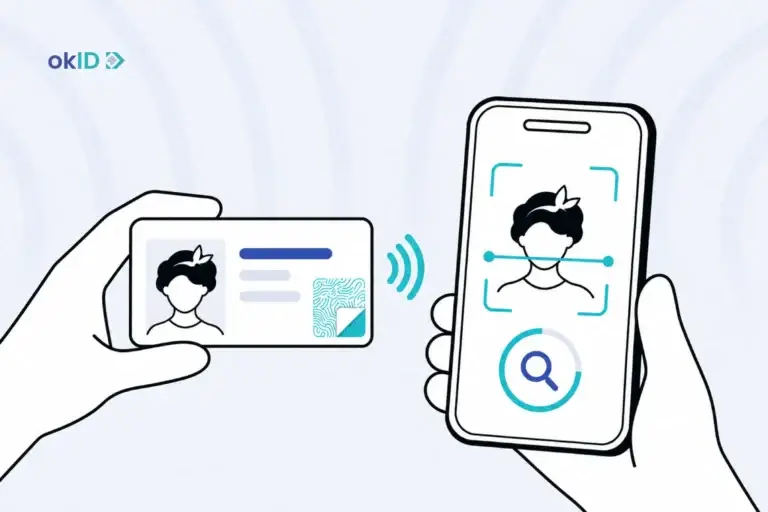
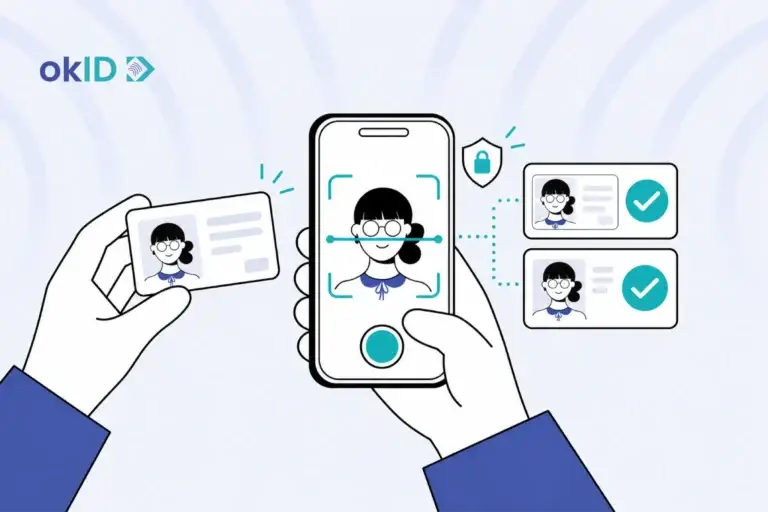
Biometrics become stronger when connected to document verification. A selfie match can confirm whether the person resembles the portrait on an ID document. Document verification can then check whether the document looks valid, altered, expired, stolen, or inconsistent.
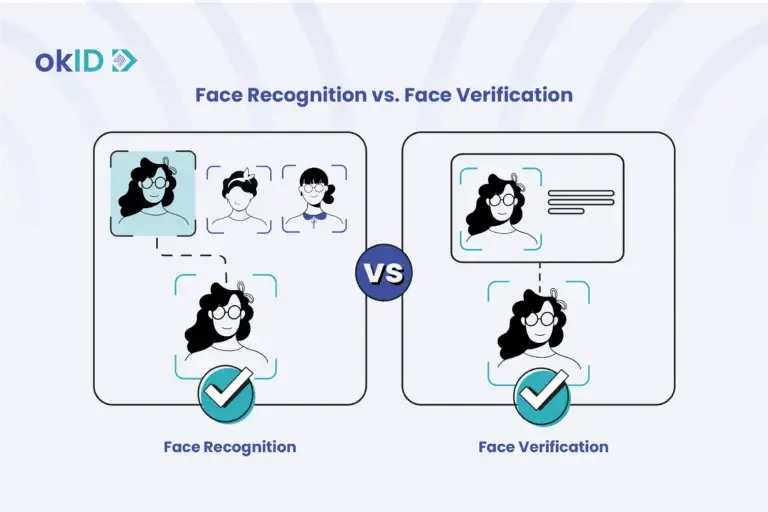
This is where biometric face recognition software adds business value. It connects the person, the document, and the verification session. A face match alone is not enough if the document is fake. A valid document is not enough if the person presenting it is not the rightful holder.
Adopt Multi-Layer Identity Verification
A practical example is okID’s biometric face recognition product, which combines OCR, MRZ and barcode reading, ID document verification, biometric checks, NFC validation, liveness detection, face matching, deepfake prevention, bot detection, geo-blocking, fraud intelligence, and AI-assisted analysis into a single workflow.
This matters because spoofing attempts rarely involve only one weak signal.
A fraudster may use a deepfake face, a manipulated document, a suspicious device, and abnormal onboarding behavior together. A layered system can evaluate these signals as part of a connected risk picture rather than treating each check in isolation.
For businesses, that creates two advantages at the same time: stronger fraud resilience and better conversion for legitimate users.
Anti-Spoofing Checklist for Businesses
Before choosing or reviewing a biometric verification system, businesses should ask:
- Does it detect photos, screens, replay videos, masks, and deepfakes?
- Can it identify virtual camera or injection attempts?
- Does it verify the ID document, not just the selfie?
- Does it support NFC chip reading for stronger document checks?
- Are device, IP, behavior, and session signals analyzed together?
- Can high-risk users be stepped up without slowing everyone down?
If the answer is no to several of these questions, the system may be too dependent on a single biometric check.
Why Anti-Spoofing Technology Alone Is Not Enough
Anti-spoofing technology is essential, but it is not the full answer. Attackers not only attack the biometric sample. They attack the process around it.
A system may detect a printed photo but miss a manipulated document. It may catch a replay video but miss an injection attempt. It may verify a face but ignore risky device behavior, unusual location patterns, or repeated attempts to create accounts.
That is why single-layer protection creates blind spots.
okID addresses this by supporting a broader verification workflow rather than just a single biometric checkpoint. Its approach combines high-accuracy data extraction, biometric checks, NFC capabilities, fraud protection, and an intuitive customer journey. For industries such as finance, insurance, real estate, travel, payments, and automotive, this balance is critical. The plan is to make fraud harder while keeping legitimate customers moving.
In e-commerce and other high-volume digital environments, businesses may also need broader tools to evaluate account behavior, transactions, and payment risk. A dedicated guide to fraud prevention software for e-commerce can help teams assess those additional controls.
The Future of Biometric Spoofing
Biometric spoofing will become more adaptive. Fraudsters will use real-time deepfakes, AI-assisted impersonation, synthetic identity networks, deepfake-as-a-service tools, and automated attack workflows to test verification systems at scale.
Future attacks will not always look like a single person trying to fool a single camera. They may involve coordinated fraud operations that generate fake documents, synthetic faces, voice clones, device manipulation, and account behavior patterns.
Biometrics are not the problem. The problem is treating them as the whole answer. Future-ready verification will depend on adaptive risk analysis. Businesses will need platforms that can evaluate biometric signals, document authenticity, NFC data, fraud intelligence, device context, and session behavior together.
okID is built for this kind of environment because its verification approach does not rely on one static control. Combining multiple identity and fraud signals gives businesses a more flexible foundation as spoofing techniques evolve.
The future of biometric fraud will not be solved by adding more friction to every user. It will be solved by smarter verification flows that quietly identify risk while letting genuine customers move forward.
Conclusion
Biometric spoofing has become a real business risk because attackers now have better tools, better data, and easier access to AI-generated media. Photos and replay videos are still a problem, but deepfakes, injection attacks, and synthetic identity tactics are pushing the threat into a more advanced stage.
Businesses should not respond by abandoning biometrics. They should stop treating biometrics as a standalone defense. A stronger strategy combines liveness checks, document verification, biometric matching, NFC reading, device and session signals, and fraud intelligence. That layered approach helps businesses detect spoofing without creating unnecessary friction for legitimate users.
For business leaders, the important question is not whether biometric spoofing will continue to evolve. It will. The real question is whether your identity verification process can evolve faster than the fraud attempts targeting it.
FAQs
1- Can biometric spoofing create compliance risks?
Yes. If spoofing allows a fraudster to pass onboarding or access a regulated service, the business may face KYC, AML, audit, or regulatory concerns. The risk depends on the industry, jurisdiction, and whether the company can demonstrate that it used reasonable identity-verification controls.
2- How can businesses reduce biometric fraud without hurting conversion?
They should avoid adding friction for every user. A better approach is risk-based verification. Low-risk users move through a smooth flow, while suspicious sessions trigger stronger checks, manual review, or additional verification layers.
3- Can biometric spoofing happen during remote onboarding?
Yes. Remote onboarding is a common target because the user is not physically present. Attackers may use stolen documents, manipulated selfies, replay videos, deepfakes, or synthetic identities to pass verification.
4- How can businesses test whether their identity verification process is vulnerable to biometric spoofing?
Businesses should test against both presentation and injection attacks, including photo attempts, replay videos, deepfake selfies, virtual camera feeds, fake documents, and suspicious device patterns. They should also review whether fraud signals are evaluated together or treated as isolated checks.
5- Is biometric authentication alone enough to prevent identity fraud?
No. Biometric authentication is useful, but it should work alongside document verification, liveness checks, device intelligence, session monitoring, fraud rules, and risk scoring. Identity fraud usually involves multiple signals, so the defense should evaluate those signals together.